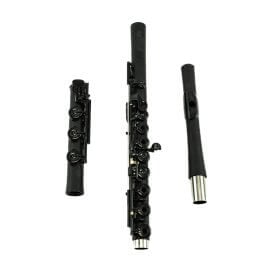
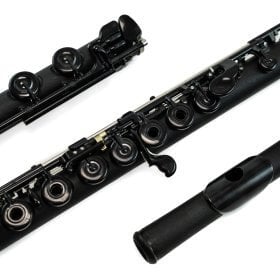
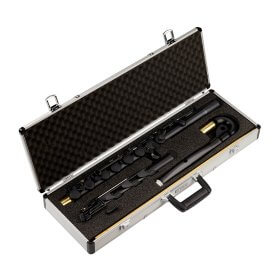
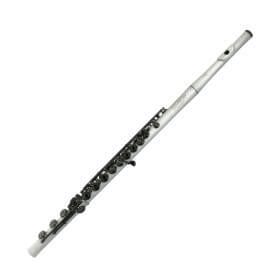
The Guo Musical Instruments Company (GMIC) began in 1988 with humble roots. Initially, their handcrafted flutes made only minor adjustments to the traditional Boehm system. However, in 2003, they introduced the Cermet Flute, marking the beginning of an innovative journey in flute design and manufacturing. This breakthrough, which continues to be a defining feature of all GMIC instruments, utilized computerized engineering for every aspect of construction and design. This approach ensured a level of consistency and reliability that was unmatched by previous methods.
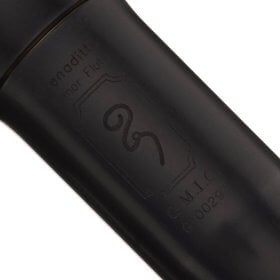
In 2004, inspired by Mark Dannenbring, a flute professor at Donghai University in Taiwan, Geoffrey Guo, the company’s founder, began exploring new ways to design flutes that captured the exceptional air response of Baroque conical flutes, while remaining suited for modern performances. Their early experiments led to the creation of the Executor headjoint, made from a composite material called Grenaditte. This man-made material closely resembles Grenadilla wood in terms of density, acoustics, and color. The Executor’s versatility and tonal success inspired GMIC to create an entire flute using this unique material.
The Grenaditte flute was an extension of the company’s ongoing research into the response of air in the flute tube. By slightly modifying the Grenaditte material, Guo was able to design a flute that mimicked the air response of a conical tube while retaining the full range of a modern instrument. This flute outperformed both silver and wood in various aspects, including intonation, dynamic response, and overall tone color. The concave crown and varying material densities throughout the flute allowed for a surprisingly broad, colorful tone with exceptional intonation and ultra-responsive dynamics. Furthermore, the material’s resistance to weather changes and lightweight construction made the Grenaditte flute ideal for precise manufacturing methods reliant on computerized graphics. While its sound is reminiscent of earlier conical flutes, the Grenaditte flute is also capable of expressing music from all time periods, providing the ideal balance of equal-tempered intonation and early flute tonal qualities—a long-elusive achievement now possible due to GMIC’s innovative approach.
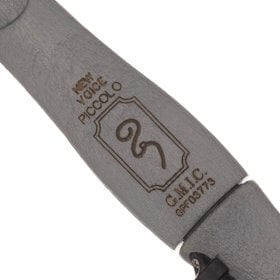
In 2009, GMIC introduced the New Voice Flute, a further advancement in their quest to revolutionize flute-making. The New Voice Flute’s body is made entirely from engineered high-polymer plastics, making it even lighter than the Grenaditte flute. The flute’s response is closer to that of the traditional Boehm system flutes, but with greater tonal freedom. Flutists, both students and professionals, found the instrument easy to play, offering a rich, robust sound ideal for those who desire more from their flute without straying too far from the familiar Boehm system’s cylindrical design. Unlike the Grenaditte flute, which comes only in a deep, blackwood-like color, the New Voice Flute is available in a variety of colors, thanks to the flexibility of the modern materials used in its construction.
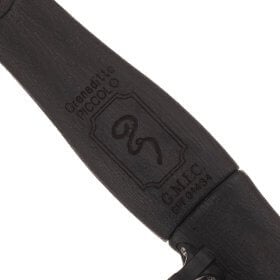
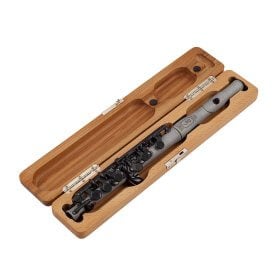
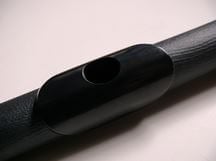
Not resting on their laurels, GMIC expanded its vision in 2010 beyond the traditional C flute. That year saw the introduction of new instruments, including piccolos and bass flutes, made from either Grenaditte or New Voice materials. These instruments received a warm reception at the NFA Convention in Anaheim. Additionally, the company filled a 200-year gap in flute design with the creation of the G soprano flute, available in both Grenaditte and New Voice options. The G soprano flute bridges the gap between the high, bright sound of a piccolo and the more subtle, colorful tone of a C flute. GMIC is also working on the development of alto and damore flutes, further expanding their innovative line of instruments. As the company continues to push the boundaries of flute design, it is clear that GMIC’s commitment to creativity and craftsmanship will keep flutists around the world excited for what comes next.