
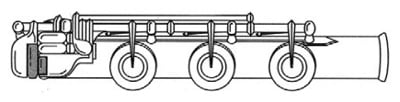
Rollers
Rollers are employed to facilitate the movement of the right hand 4th finger on the footjoint keys. While rollers are always present on the C and B keys, often the player finds added facility with the addition of other rollers. Shown are D# and C# Rollers. The more common D# Roller is available on most custom made-to-order instruments, but on only a handful of production instruments. The C# Roller is readily available on several Miyazawa models in combination with the D# Roller.

Split E Mechanism
This mechanism physically splits the double G keys. When playing G, the keys behave as normal, closing both of the G keys via an adjustment tab (or screw) between the two. When fingering high E (3rd octave), the mechanism closes the lower of the two G keys, creating an ideal venting system to stabilize this usually troublesome note. Now you can attack the high E with confidence, slur from high A to E, and you’ll also notice an improved intonation on the E. Many see the musical advantage while some prefer not to add the additional mechanism, citing a difference in feel in the right hand.
Note: Many companies offer the Split E only on flutes with offset G keys; creating it on inline flutes is problematic. A Split E with a “clutch” means the mechanism can be deactivated.
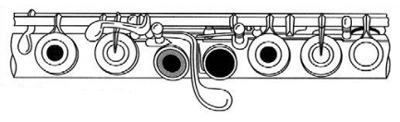
High E Facilitator
Known as the “donut” for its striking good looks, it is a simple washer-looking item (of various materials) that is inserted in the lower G hole and serves as an economical alternative to the Split E. It provides many of the same benefits but is completely unobtrusive and does not add noticeable weight to the flute. We can install an E facilitator on any flute. This can be removed later if so desired.
C# Trill Key
The C# trill key is an extremely useful mechanism with which all flutists should be acquainted. Almost all professionals buying flutes today choose to get the C# trill key. In addition to offering new fingerings for various trills and tremolos, the C# trill key can also be used to provide a more stable and colorful middle C# when activated while B-natural is fingered. The following are the various uses for this key.
Trills
B-C# (first and second octaves): Finger Band trill the C# key.
C-C# (first and second octaves): Finger Cand trill the C# key.
High F#-G#: Finger high F# and trill theC# key.
High G-G#: Finger high G and trill the C# key.
High G-A: Finger high G and trill the C# Trill key and D Trill key in unison.
High Ab-Bb: Finger high Ab and trill the C# Trill key, the D Trill key, and the D# Trill key in unison.
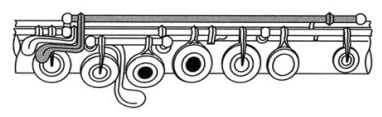
Tremolos
In the first octave: Tremolo to C# from G, Ab, A, Bb, B, or C by trilling the C# Trill key.
In the second octave: Tremolo to C# from A, Bb, B or C by trilling the C# Trill key. In the first octave: Tremolo to D from G, Ab, A, Bb, or B by trilling the C# Trill key and the D Trill key simultaneously.
In the first octave: Tremolo to D# from G, Ab, A, Bb, or B by trilling the C# Trill key and the D# Trill key simultaneously.
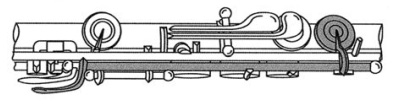
B or C Footjoint
The flute’s footjoint will normally be built to low C or B. The B Foot extends the range of the flute down one half step making B the lowest note available. As a result, the foot is lengthened by about an inch.
While the low B is increasingly used in repertoire, the extension of the tube has other effects as well. The longer tube creates more resistance in the low register, having a longer air column to “push.” Some see this as positive; others prefer the ease of response on a C Foot. Currently, the B Foot isthe standard in the American market. For that reason, the C Foot is not always readily available. In this catalog, we’ve listed prices for the B Foot only, but we are happy to quote pricing and availability of flutes with a C Foot at your request.

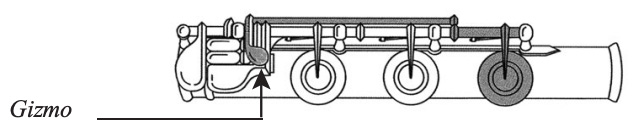
Gizmo
The high C facilitator, frequently referred to as the “gizmo,” closes the low B key, providing clear response of the fourth octave C. The high Cfacilitator isstandard on most B Footjoints.
Inline or Offset G Keys
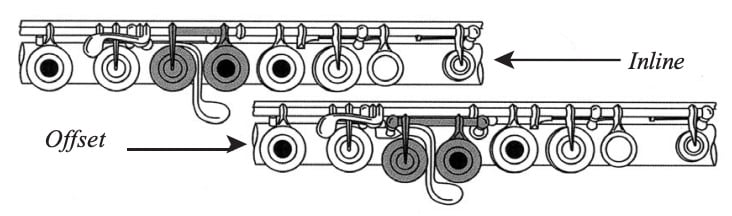
For yearsin this country, student flutes were sold with plateau keys and offset G keys. Most professional flutes were sold with open holes and inline G keys. As a result, people viewed the inline as the professional mechanism. In fact, we often hear that an offset G doesn’t “look” professional.
While some consider the inline the only choice for better flutes, we find ourselves selling mostly offset G instruments. This may be the result of flutists experiencing that the offset G can facilitate a more relaxed, natural left-hand position. Neither inline nor offset has a tone advantage, but mechanically the offset keys have a slight advantage. Being mounted on a separate set of posts with their own arbor, the left-hand key system is more stable and less likely to bind up. This binding can be problematic on high F# to F Trills. A few companies have diminished the mechanical disadvantage of an inline G set up with clever bridging of the mechanism to eliminate pins.
Open or Closed Holes
French open-hole keys require that the player cover a hole in the center of the key
cup. The open holes are located under the 2nd and 3rd finger of the left-hand (A and G), and the 1st, 2nd, and 3rd fingers of the right-hand (F, E, and D). While favored by most flutists, legitimate arguments for plateau (also called closed or covered) keys abound. I’m going to disappoint the plateau proponents, though, by limiting my discussion to the benefits of open holes. Sorry!
Open holes can be used for effects such as bending or shading, and the player can vent some holes to adjust pitch when playing softly on high register notes. Playing open holes requires and therefore develops fingering accuracy that is not essential on plateau keys. Some clever trills make use of the open-hole venting for better pitch. Because most fine flutes are built with open holes, the selection of flutes available is many times greater. If one insists on plateau, he/she may have to special order a flute and might be required to pay before knowing if the flute meets expectations. Open-hole flutes can be used as plateau flutes by inserting plugs in them.
We ship all flutes with plugs so that a musician new to French open holes can easily play the instrument. One can remove a plug at a time until the technique and feel is developed. I recommend taking out the A first then the F. From there, take out the E. Lastly, remove the 3rd fingers, either the G or D first depending on the individual. Since open-hole flutes are the standard, they will retain their resale value.

Soldered or Drawn Toneholes
Most flutes are manufactured with drawn and rolled tone holes. The process involves punching a small pilot hole in the body tube and using various types of tools to form the tone hole by pulling metal up from the tube. Then the top is milled flat, and the top of the hole is rolled off. Once a flutemaker sets up for drawn holes, it is a very efficient and economical way to produce the holes.
The soldered process involves machining the actual hole, then soldering it to the body tube. Once mounted, the hole in the tube is milled out. Makers use different materials to solder the holes. Most older flutes are soldered with lead enabling easy repair of tone holes, but lead usually requires frequent attention as leaks form once the lead deteriorates. Silver and gold solders are used today as a response to the joint leakage problems, but repair of bent tubes and so forth are much more involved. Good news/bad news. Soldered holes are indicative of the highest order of flutemaking because of the extra time element involved. Flutes with soldered holes usually range upwards of $10,000. This discussion then is of less interest to those buying instruments in lower prices ranges since it is not an option.
People do not always agree on the sound difference between the two. This is partly because one cannot easily compare an instrument with soldered holes and the same exact flute with drawn holes. In my experience, the drawn-hole flutes play a little freer – with more abandon. The soldered-hole flutes play with more reserve. Some view soldered holes as resistant and dark. This is often desirable. Sometimes not.
Wall Thickness
The thickness of silver flutes vary between .014″ and .018″. Fourteen thousandthsis considered thin wall, sixteen thousandths being medium wall, and eighteen is heavy wall. In foreign-made instruments, we see the metric equivalents which roughly correspond. Gold flutes are usually .012″.
The thinner wall instruments tend to play “lighter” with a freer, brighter and a little more lively sound. The heavy wall instruments play with more resistance and
a darker sound. The choice is a matter of personal preference, and one cannot disregard the interplay between material, design and wall thickness. For example, a .012″ gold tube flute will probably sound darker than a .018” sterling tube. Sixteen thousandths(.016″) is standard for sterling silver flutes, and most flutists find that this suits their needs perfectly. Almost all handmade silver flutes can be ordered to your choice of .014″, .016″, or .018″.
Gold Springs
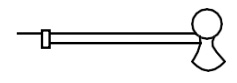
Because of the cost of gold, these springs are standard only on the more expensive instruments. On most other instruments, the makers use stainless steel. The stainless steel is reliable and has a decent feel, but the feel of the gold springs is superior. Gold springs can be adjusted to a lighter tension and still behave as a spring should. They offer the same resistance throughout the range of motion. With a stainless steel spring, the resistance increases.
French Arms
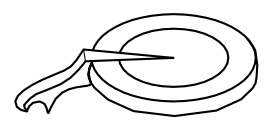
The arms of the keys connect the key “cup” (which holds the pad) to the key hinge tube. A typical key has an arm that connects to the back side of the cup. French arms connect at the back and across the top of the key, ending in a nice point in the center of the cup. French arms are not found on the keys that have open holes.
Because French arm keys look elegant, they are sometimes dismissed as a cosmetic attraction. While the appearance is pleasing, my respect for this feature goes beyond aesthetics. French arms are indicative of a higher level of flute building. They require more skill, time, and precision.
A company using pointed keys requires better technique for padding the instrument because the assembler cannot tilt the key to and fro to achieve a proper seal. The musician can play with a nice light touch because the arm takes the pressure of the fingered key and applies it directly to the center of the pad – not the back.

Adjustment Screws
Most flutes feature strategically placed adjustment screws. When the screw and its surrounding lug are made with a fine thread and fitted properly, the system works reliably. When it is poorly made, the flute goes out of adjustment easily. Poorly made flutes have given adjustment screws a bad rap. Flutes built without adjustment screws are more time-consuming to manufacture and therefore are more expensive instruments. These instruments require the servicing of a highly skilled technician. Few technicians are qualified to repair handmade flutes, and an instrument can be compromised by poor repair work.
Scale and Pitch
Many people confuse scale and pitch. Pitch is the frequency at which the instrument is designed to play its best (in tune). The old standard at which flutes were built is A=440, that is 440 cycles per second. Today’s standard is A=442.
European orchestras often tune sharper than their American counterparts. As a result, the A=444 flute is primarily used abroad. Some American orchestras now tune at A=442, but even at A=440, A=442 flutes perform beautifully.
The instrument’s scale is the relationship of the toneholes to each other, the size of each hole, and the distance of the toneholes from the embouchure hole. The significance of the scale cannot be understated. A good scale will help the musician play with better intonation while expending less effort. The scale is largely responsible for the quality of “the voice” of each note.
No one perfect scale exists. The better flutemakers develop a pattern of hole
placement that differs slightly from their competitors. Some start with a scale that is
widely accepted and then improve upon it. Others approach it mathematically, using formulas that work at least theoretically. Regardless, the flutemaker needs to apply the results of experimentation and feedback from musicians.
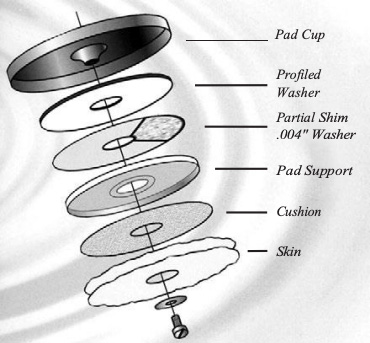
The Straubinger Pads
Straubinger Pads were designed specifically for handmade flutes. The design of the pad ensures that it is virtually impervious to changes in temperature and humidity that cause felt pads to expand or contract. Straubinger Pads also have an extremely firm and flat surface. This creates a more precise seal, resulting in increased resonance and clarity of sound.