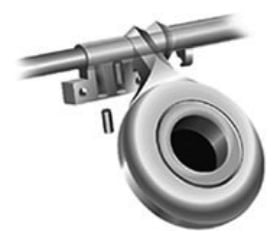
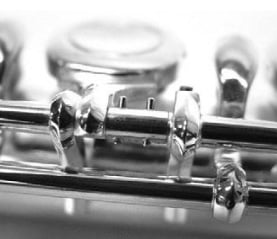
Brögger Mekanik™
Developed by Danish flutemakerJohan Brögger and produced by Brannen Bros., the Brögger Mekanik™ uses non-rotating shafts and full-size back connectors for all main line keys. This reduces some mechanical problems found on standard Boehm pinned flutes including binding between the G and Bb on inline flutes, and adjustments between the D and E to the F#, and between the A and Bb.
The Brögger Mekanik™ flute also is noticeably quieter with reduced friction and far less wear to its moving parts. Additionally, this mechanism allows the technician to adjust the spring tension of each key independently of any other, allowing for a much more even feel.
The mechanism is a very strong design, and it must be built with a high level of skill because of very tight clearances. If this flute receives damage, it requires a high degree of skill to repair the instrument.

Brögger System
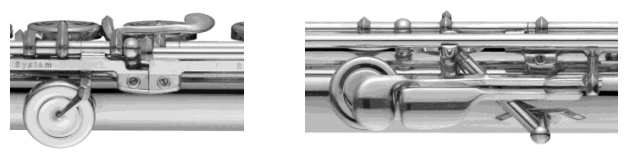
Featuring many of the attributes of the Brögger Mekanik™, the Brögger System combines curved coupling rods, double conical tone holes, and a unique thumb key mechanism. The Brögger System has been produced on certain model Miyazawa flutes since 2005.
The Brögger thumb key uses a longer hinge tube mounted at an angle which gives it more stability and resistance to wear. The key uses a straight spring like all others on the flute, replacing the traditional flat spring here.
Kingma System
The revolutionary Kingma System mechanism is designed by Dutch flutemaker Eva Kingma and has been licensed for use by several manufacturers including Sankyo and Brannen Bros.
The Kingma System is the first flute design to offer a full quartertone scale, as well as complete multiphonic venting. The basis of the system is a standard Boehm system with a C# trill. It can be played as a standard flute by just ignoring the additional keys. Therefore, it doesn’t require the musician to “re-learn” anything.
Where the fun startsis with the six extra keys. These are installed by means of the patented Kingma “key-on-key” system. These keys are used to produce six of the seven quartertones and multi-phonic vents, which are not found on a standard flute. The seventh quartertone is achieved by using the C# trill key together with the C key. The other five quartertones are produced by using the normal, open-hole keys. With the Kingma System, the flutist can play a complete and accurate chromatic scale, chromatic quarter-steps and chromatic multiphonics as well, while controlling pitch to a new found degree.
Since the Kingma system opens the door to a range of musical possibilities that a standard Boehm system does not, it is my prediction that this mechanism will become increasingly popular. Particularly so when manufacturers build the system on affordably priced instruments.
Pearl Pinless
Pearl flutes use a patented “Pinless” construction, which eliminates traditional key pins. Pearl replaces pins with socket head set screws, which are hidden when the flute is assembled. The screws are mounted from the underside of the keys and are set into corresponding “flats” which are milled into the steel key shaft. Additionally, Pearl uses what they dub a “One Piece Core-Bar”. Thisis a steel key shaft that travels the length of the mainline keys from the left hand C, to the right hand D, thus eliminating issues with fit and binding issues at the C and the F# area. This design resolves troubles at the “King post” that holdsthe right hand F# and the left hand Bb.
We hear from many technicians who claim they don’t enjoy working on this mechanism, but I feel they just haven’t had enough experience with them. To service the Pearl flute requires a special wrench (which we sell).