

Flute World would like to feature Jack Nesser, an Indiana-based high school musician with great talent and drive. Entering his senior year at West Vigo High School in West Terre Haute and studying band under Chris Gelb, Jack is already an award-winning composer, community musician, and talented flutist. He is the winner of the 2022 Hayes School of Music Composition Contest, and Indiana All-State Honor Band participant, and recently won first prize at the Sycamore Flute Soloists Competition.
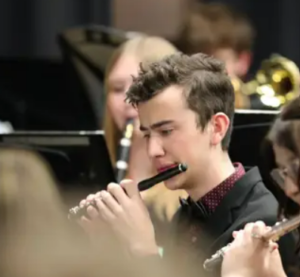
FW: Flute players tend to listen to flute music. And when we do listen to ensemble music, many tend to hone in on the flute line. Who are some flutists that inspire you? And what other types of music would you recommend flute students listen to in order to broaden their musical horizons?
JN: My instructor, Dr. Angela Reynolds, is my biggest inspiration for everything flute. Along with being an amazing human being and educator, she is an astonishing flautist. I have watched many performances of her in chamber ensembles and with the Terre Haute Symphony Orchestra, and I strive to add the character and personality she exhibits in her performance in my playing. I’d have to say the other flautists who inspire me are the flautists my own age. I have connected with many high school flautists around the Midwest through camps and honor bands and watching what they are doing with their tremendous skill and hard work really inspires me to keep doing what I am doing.
If I were to recommend music to someone, I would first ask them what music they are listening to now. If it is primarily symphony orchestras playing classical music, I would recommend they branch out and find some wind ensemble music or chamber music to listen to, or vice-versa. They should also keep in mind the time frame. Classical music has changed quite a bit from 1500 to 2023, so maybe finding some modern or medieval works would help expand your listening. Also, try listening to music they never listen to. Maybe that’s rock, jazz, indie, pop, or anything! Just hop on Spotify or YouTube, be curious and listen around. Ask your friends to send you their playlist and pick a few songs to listen to. You never know what you might like!
FW: Writing for ensembles requires an understanding of many different instruments. What are some recommendations you would give to flutist/composers to help them hear beyond the flute line? How can this practice helped you be a better player in an ensemble?
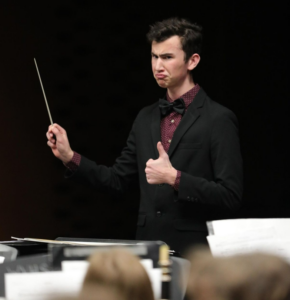
JN: I think the biggest way to broaden your ear as a composer is to not only pay attention to how your part fits in with the ensemble, but how everyone else’s part fits in as well. What are the french horns doing across the room? What is the clarinetist behind you doing? How do those parts fit together? etc. Also, listen to those moments that give you the wow factor or pull at your heart strings. What made you feel that way? Was it the chord progression or maybe the melody? What was going on musically in the ensemble that made that happen? It’s all about being curious and opening your ears. Asking myself those kinds of questions has helped me tremendously in my composing as well as my performance in a large ensemble. When performing, you have to ask yourself, “What are the important parts?” If I have the melody, I need to listen if I have that same part with anyone else and balance to them. Or maybe I’m playing the same staccato eighth notes over and over again on an Ab, which clearly isn’t as important as the low voices playing the moving line, so I’m going to back off a little bit. Being a conscious musician is the next step to improving your large ensemble performance and to becoming a better composer.
FW: When did you write your first piece? What inspired you to try? What were the biggest challenges to start/finish?
JN: I wrote my first big piece, To New Beginnings, in the winter/spring of 2021 in the heat of Covid-19. The previous year I had created an arrangement of Bridge Over Troubled Water. I gave it to the director of the Terre Haute Community Band, an ensemble I joined the previous year, and we ended up performing it at a concert. I don’t remember what fueled my energy to create that arrangement, but I remember when we hit that first chord in the piece in rehearsal, I melted. Although Bridge Over Troubled Water wasn’t my song, that feeling I got when the ensemble played my arrangement was something I wanted to feel over and over again. I found a way to express myself in a really awesome way, and that was my inspiration for composing my first work. My biggest challenge with the work was what to do next as the piece went along. I remember I had the beginning and ending written pretty early on, but figuring out the structure in the middle was difficult. I ended up doing things that I had picked up on in ensemble playing such as modulations, ABA form, and using previous ideas to make something new. Also, notation was a big challenge. When To New Beginnings was premiered, the members of the Terre Haute Community Band had to read some pretty funky notation that wasn’t as clear as it could have been (sorry everyone!), so making sure what I was writing was readable was a challenge for me as well.
FW: What types of ensembles have you participated in through high school, and how have your experiences influenced you as a composer?
JN: Thoughout high school, I have participated in my school’s concert, jazz, marching and pep bands, as well as numerous honor bands with ISU (Indiana State), EIU (Eastern Illinois), and IBA including the All-State Honors Ensemble where I was principal flute in 2023. I also have played in many community ensembles with churches, St. Mary-of-the-Woods College, Indiana State University, and Terre Haute Community Band as well as the Virtual Concert Band during Covid-19. All of these ensembles have influenced me as a composer simply because I was being surrounded by so much ensemble music. Playing in so many different kinds of ensembles has opened up my world in the perspective of what music is out there. Being exposed to so much music gives me many opportunities to use those styles and ideas in my own works. The great composer Igor Stravinsky said “Lesser artists borrow, great artists steal,” and I’ve used the philosophy of “stealing” in my own works. Now, I am not claiming John Mackey’s music as my own, but I did steal the way he uses his mallets in Aurora Awakes, which is one of my all-time favorite pieces, in shaping the framework for my piece, Sunshine River. In jazz band, I remember this really cool chord we only hit once in Sammy Nestico’s Orange Sherbert that I wrote down to use in a piece down the road just because I liked the way it sounded (remember when I mentioned being a conscious musician, it comes in handy!). So just by being surrounded with new music by a wide variety of composers that have unique styles of composition have greatly influenced my own personal style of composition.
FW: How do you balance school requirements with your passion for music?
JN: HAHA, you can balance those? Kidding aside, school always comes first, but I find any time out of my day to devote to music that I can. Sometimes, especially this past year, I’ve found it very difficult to be in the mood to do creative work from the stress and burnout because of my academic work. It was very overwhelming, and because of that, I wasn’t able to compose and practice as much as I wanted to, but I still continued to do as much as I could. Whenever you have a true passion and heart for something, you will always find the time to do what you need to do.
FW: How do you approach practicing the flute? Has composition influenced or affected the way you play and practice flute?
JN: I typically approach my flute practice around the pieces that I am working on at the moment. A very helpful technique my instructor Dr. Reynolds recommended to use was to shape my warmups around something I’m struggling with in my piece or etude. For example, for my All-State audition etude I was struggling with clarity on octave jumps, so for my warmups, I added in octave exercises, and that greatly improved my abilities in that etude.
Because I have composed, it has changed the way I approach practicing flute because I am able to look at a piece and ask myself, “Ok, what did the composer want out of this from me?”. In composing, you have to instruct your performer how to play a piece of music with you standing by their side telling you had to play it, and because I now understand the attention to detail that I have to put in my pieces to make that happen, I look for it in pieces I am performing on flute.
FW: What are some of your favorite flute etudes and pieces to play? What piece has had the most influence on you as a performer so far? Is there a piece you’re excited to learn in the future? What’s next?!
JN: My favorite pieces to play on flute are Les Foiles d’Espagne by Marais and Syrinx by Debussy. On piccolo, I have recently fallen in love with Amanda Harberg’s Hall of Ghosts and I love the piccolo part to Rossano Galante’s Transcendent Journey and John Williams’ Midway March. I think Les Foiles has had the biggest impact on me as a performer because it really taught me how to take up my performance space with its dance-like nature. It brought me out of my performance shell and allowed me to actually turn my playing into a true performance. I am currently working on Philip Glass’ Serenade and Bach’s Sonata in C Major for college auditions in the fall and winter. Compositionally, I will be releasing two works for orchestra, two recently premiered choral works, and a flute and piano piece I wrote for a friend of mine. I have some band, chamber, and choral projects I plan on finishing throughout the summer. I plan to always have a next, and a next, and a next!
For more on Jack’s music, visit his website: https://www.jacknessermusic.com/music
Give his music a listen. Eridanus for flute choir!
