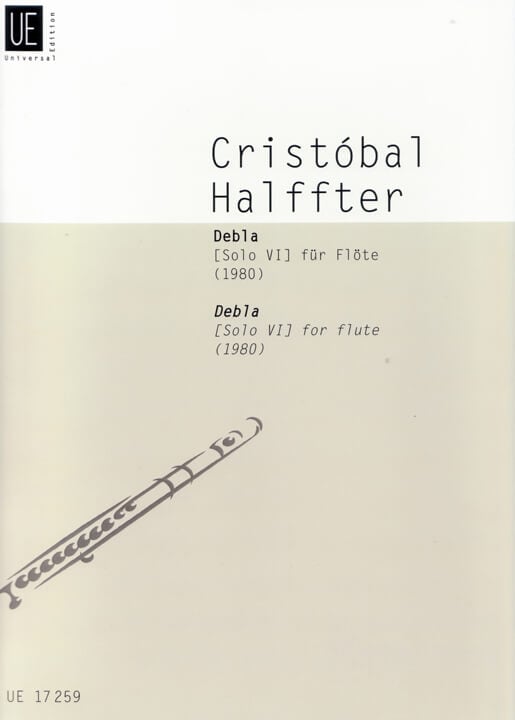
At the express wish of my friend Hans Werner Henze I wrote this work in the spring of 1980 for the Montepulciano Festival of that year. It was frist performed at the Festival by my daughter Maria.
“Debla” denotes one of the forms of the so-called “Canto grande”. This latter is in itself the purest manifestation of the Andalusian folk melody, a complex form of song which is closest to the mysterious origins of the folklore of Southern Spain.
Its salient characteristics are:
a) it is sung completely unaccompanied;
b) it consists of extremely slow, static sections followed by highly rhythmic and intense sections;
c)at the “climax” the singer beats out the rhythm by clapping, this is serving as contrast to the vocal line;
d) the music makes use of quarter-tone intervals.
I have included all of these features in the present work, although it was not my intention to imitate or reproduce the “Debla”. Rather, I have based my composition on certain aspects and characteristics of this form of Andalusian folksong while creating a work which exists in its own right and is conceived exclusively for the flute.