
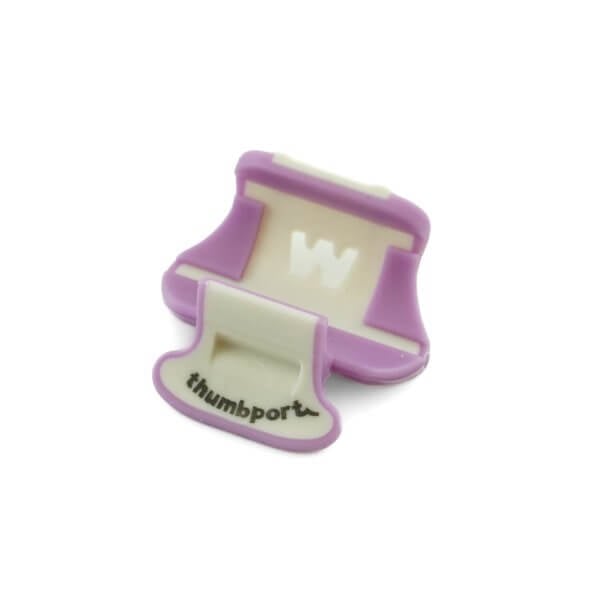


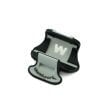
Why the Thumbport?
Being made from a round tube, the flute tends to roll while being played, and has inherent balance issues.
The Thumport counters the rolling, and helps establish a stable three-point balance support system freeing the musician from the effort of trying to physically control the instrument. The stability gained when using a Thumbport will help the musician produce a better and more consistent sound, and will aid in improved facility while reducing stress on fingers, hands and arms.
Installing the Thumbport:
Before installing the Thumbport for the first time, wipe off the area with rubbing alcohol. This will reduce the likelihood of the Thumbport moving when in use. Because the contact surface is made of a soft plastic, it does not slide easily once in place on a clean surface.
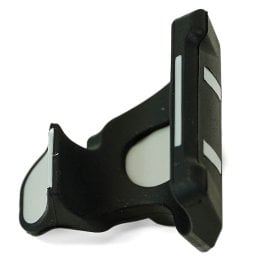
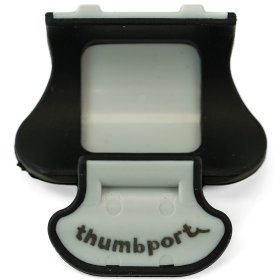
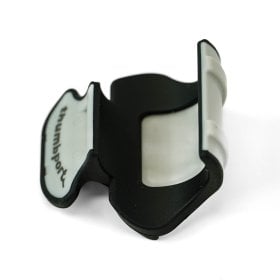
Snap the Thumbport onto the flute at around the F key where you would normally rest your thumb.
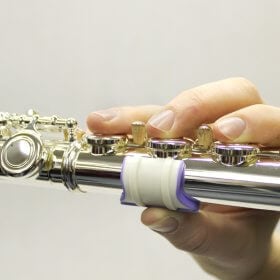
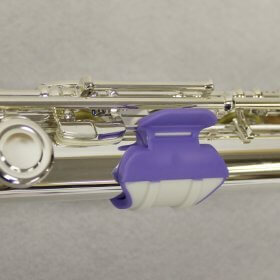
Holding the Flute:
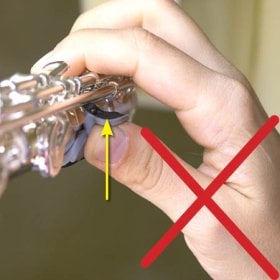
The right thumb should push against the flute at “A” (image below) at an angle of 30° to 45°. The arm of the Thumbport should rest naturally on the side of the thumb at “B”. You can move the Thumbport toward or away from the keys depending upon individual requirements.
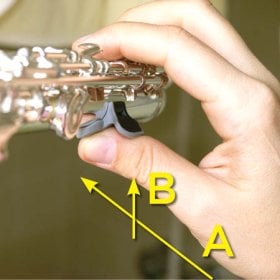
Note: Do not try to support the flute at the Thumport’s arm (image below).
The 3-Point Balance Support System:
If you learn the three-point balance support system, it will produce a steadier flute and more consistent sound.
It’s simple: try to balance the flute with only the chin, the first knuckle of the left index finger, and the right thumb (without the Thumbport initially). It may take a while to find the best spot for the right thumb, but be persistent. The thumb will eventually be supporting the flute from the back with an approximate 30° to 45° angle. Some people refer this as “supporting the flute diagonally.”
Analysis:
Mechanically, there are 3 factors associated with balancing a flute:
1. The Mass (Weight) of the Flute
2. Horizontal Rotation
3. Axial Rotation
The gravity center of a flute is located slightly to the right of the left index finger. When the knuckle of the left index finger takes up most of the weight of a flute, the small remaining weight is often assumed by the right thumb.
When playing a flute, the player pushes the embouchure plate against the chin. With the left index finger both supporting and pushing, the flute might rotate clockwise without a counter force from the right hand.
Additionally, the uneven weight of the flute mechanism contributes to another rolling tendency. The flute rolls backwards toward the player.
Because nine of our fingers are used to operate keys on a flute, only one, the right thumb, is left to decisively balance it. Many flutists knowingly or unknowingly use their right little finger to help. In doing so, it reduces the agility of not only the little finger but also the other right hand fingers.
Thumbport or Thumbport II?
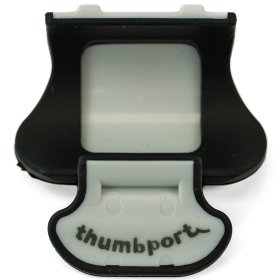
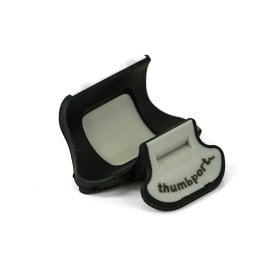
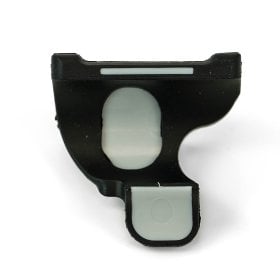
In choosing between the original Thumbport and the Thumbport II, it’s mostly a matter of preference and hand size.
The Thubmport II features a lower starting spot to support the thumb. This is due to the longer “stop” that’s located above the “wing” of the Thubmport. The Thumbport II is designed with a longer stop so that it can be cut (i.e. reduced in length) by the user to customize its position on the flute to their liking.
Comparing an unmodified Thumbport II and a Thumbport, the Thumbport II requires slightly larger hands as the thumb rests lower (creating more distance between the thumb and the rest of the fingers).


Reviews
There are no reviews yet.