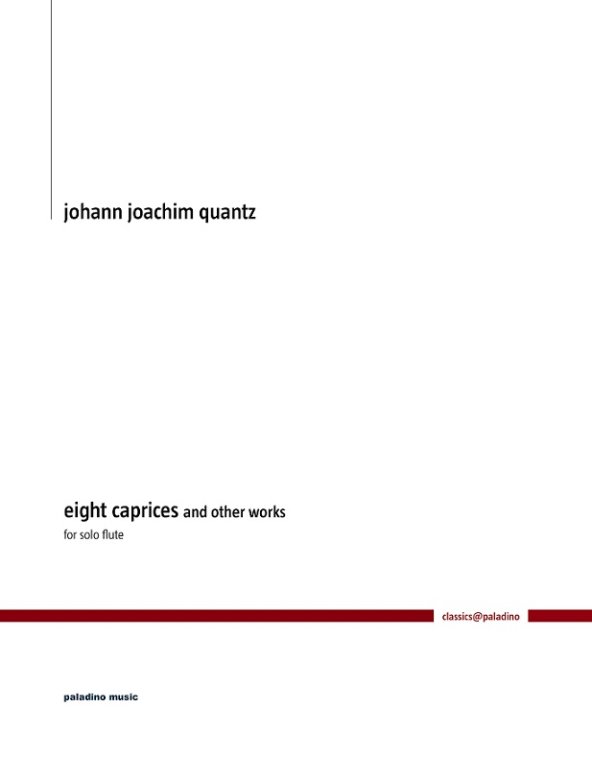


Eight Caprices and Other Works for Solo Flute
Composed by Johann Joachim Quantz
Published by Paladino Editions
Contents:
- Alla Francese No. 10 in D Major, QV 3:1.3
- Fantasia No. 1 in D Major, QV 3:1.5
- Adagio No. 51 in B Minor, QV 3:1.22
- Allegro in E Minor (by Johann Martin Blochwitz)
- Minuetto Da Capo in D Major
- Minuetto Da Capo in E Minor
- Fantasia No. 3 in E Minor, QV 3:1.9
- Allemande No. 44 in E Minor (by Johann Martin Blochwitz)
- Sarabande in G Major (by Johann Martin Blochwitz)
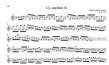
- Praeludium No. 15 in D Major, QV 3:1.7
- Capricio No. 1 in D Minor, QV 3:1.8
- Capricio No. 2 in E Minor, QV 3:1.10
- Capricio No. 3 in F Major, QV 3:1.12
- Capricio No. 4 in G Major, QV 3:1.15
- Capricio No. 5 in G Major, QV 3:1.17
- Capricio No. 6 in G Major, QV 3:1.14
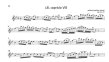
- Capricio No. 7 in A Minor, QV 3:1.19
- Capricio No. 8 in B Flat Major, QV 3:1.21
- Minuetto No. 2 in B Flat Major, QV 3:1.23
- Fantasia No. 6 in C Major, QV 3:1.1
- Fantasia No. 9 in C Major, QV 3.1.2
- Allemande No. 45 in E Minor (by Johann Martin Blochwitz)
- Menuet “L’Inconu” (by Michel Blavet)
American flutist Eric Lamb presents a rarely heard collection of 15 solo flute pieces (Fantasies, Minuets, Sarabandes etc.) and the complete Eight Caprices by Johann Joachim Quantz. The source for this edition is the manuscript preserved by the Royal Library of Copenhagen under the title Fantasier og Preludier. // 8 Capricier og andre Stykker til Øvelse for Flöÿten af Quantz.
This edition presents many of these pieces for the first time in modern print. After further research, it came to my attention that a few of these works found in this incredibly rich volume of music were indeed not by Quantz himself, but most probably by Johann Martin Blochwitz (1678–1742), a flutist and composer of the Dresden Hofapelle, or by the great French flutist Michel Blavet (1700–1768). These additions were included in the volume and adapted by Quantz due to their superior quality and I have in turn included a few of these examples in this collection. It is a wonder to me that these gems are not more often taught and performed. These pieces are far more than etudes or fnger gymnastics, but rather a telescopic look at performance practice, style and technique of the 1700s
throughout Europe. When recording this collection, we have organized it in a way to provide the listener with a sense of musical drama. We have however decided to keep the 8 Caprices together as one work. Errors such as accidentals, missing measures and rhythmic ambiguities have been corrected in accordance to harmonic common sense and performance practice. Quantz has
given suggestions as to articulation and in these cases I have attempted to follow these guidelines with a hint of playfulness and improvisation. — Eric Lamb, Vienna, February 2015